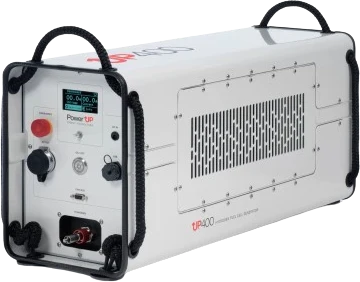
Portable generator
PowerUP UP400
400 Wpower
Mobile backup, instruments, telecom masts and emergency response in the field.
Get a quote →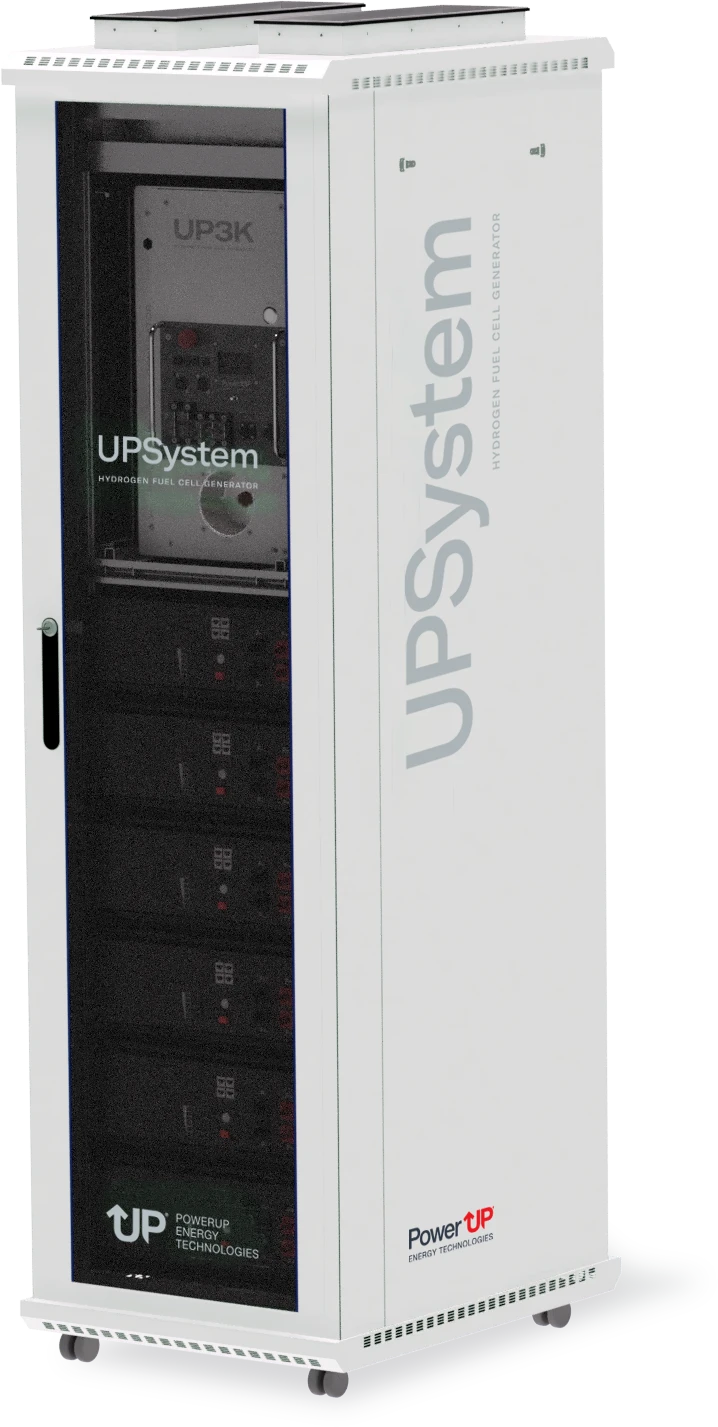
Knowledge page · Hydrogen and fuel cells
How hydrogen fuel cells are used as standby power: the technology, the transfer on power failure, hydrogen use and autonomy, safety and Danish rules – and PowerUP’s full range from 400 W to container solutions.
What a fuel cell is and how it fits into a standby power solution.
In short
A fuel cell converts hydrogen and oxygen from the air directly into DC power. There is no combustion and no moving parts in the cell itself – the exhaust is water and heat.
As standby power the fuel cell works together with a battery: the battery bridges the first seconds, and the fuel cell supplies power as long as there is hydrogen.
Today the technology is used mainly for telecom, plant rooms, emergency response and temporary installations where noise, exhaust or indoor placement rule out a diesel generator.
Operation
In a PEM (Proton Exchange Membrane) fuel cell, hydrogen is split at the anode into protons and electrons. The protons pass through the membrane, while the electrons must go around – through the load. At the cathode, protons, electrons and oxygen from the air meet and form water.
Each cell gives less than 1 V, so cells are stacked to the required voltage. PowerUP’s generators deliver 12, 24 or 48 V DC, and UPSystem and UPMobile have an inverter for 230 or 400 V AC.
Transfer
A fuel cell must start before it supplies power. A standby system therefore always has two parts: a battery buffer that takes over within milliseconds, and the fuel cell, which starts automatically and takes over within seconds. When the mains returns, the system switches off by itself.
When fuel cells are the right choice and how much hydrogen is needed.
Comparison
The fuel cell does not replace the diesel generator in a large data centre. But at low to medium power – and where noise, exhaust or placement are decisive – it is often the best solution.
| Fuel cell | Diesel generator | Battery only | |
|---|---|---|---|
| Exhaust on site | Water and heat | Exhaust gas and particles | None |
| Noise | 45–65 dB (PowerUP) | Typically needs silencing | Low |
| Autonomy | As long as there is hydrogen | As long as there is fuel | Minutes to hours |
| Placement | Indoors and outdoors; cylinders outside | Needs flue and ventilation | Battery room with cooling |
| Power range | From 400 W; larger in containers | From a few kW to many MW | Limited by autonomy |
| Fuel | Hydrogen cylinders or bundles | Diesel or HVO in tank | – |
Hydrogen use
PowerUP states a consumption of approx. 65 g of hydrogen per kWh for the UP3K. The amount of hydrogen therefore follows directly from the load and the time the contingency plan requires:
Hydrogen (kg) = P (kW) × t (h) × 0.065
A 50 l cylinder at 200 bar holds approx. 0.75 kg of hydrogen. Check the specific cylinder type with the gas supplier. The autonomy must match the contingency plan.
How the system is placed safely and which rules and standards apply in Denmark.
Safety
Hydrogen is flammable but very light and rises quickly. Safe installation is about keeping storage outside, ventilating high and shutting off the gas automatically on a leak.
Hydrogen is lighter than air and collects at the ceiling. Ventilation is placed high.
Detects leaks and shuts off the gas supply automatically. PowerUP has such a safety system for indoor generators.
Valve and pressure regulator between gas supply and fuel cell – UPSystem runs at 0.5 bar(g).
Installed to the manufacturer’s instructions and IEC 62282-3-300.
Storage of hydrogen cylinders follows the Danish Emergency Management Agency’s technical regulations for gases.
Rules and standards
The Danish Emergency Management Agency’s rules for storage of gases in cylinders, including hydrogen. The municipal fire service is the authority.
Safety requirements for stationary fuel cell power systems (EN IEC 62282-3-100:2020).
Minimum requirements for installing stationary fuel cell power systems indoors and outdoors.
Classification of zones around hydrogen where an explosive atmosphere may occur.
Where fuel cells are used and PowerUP’s full range.
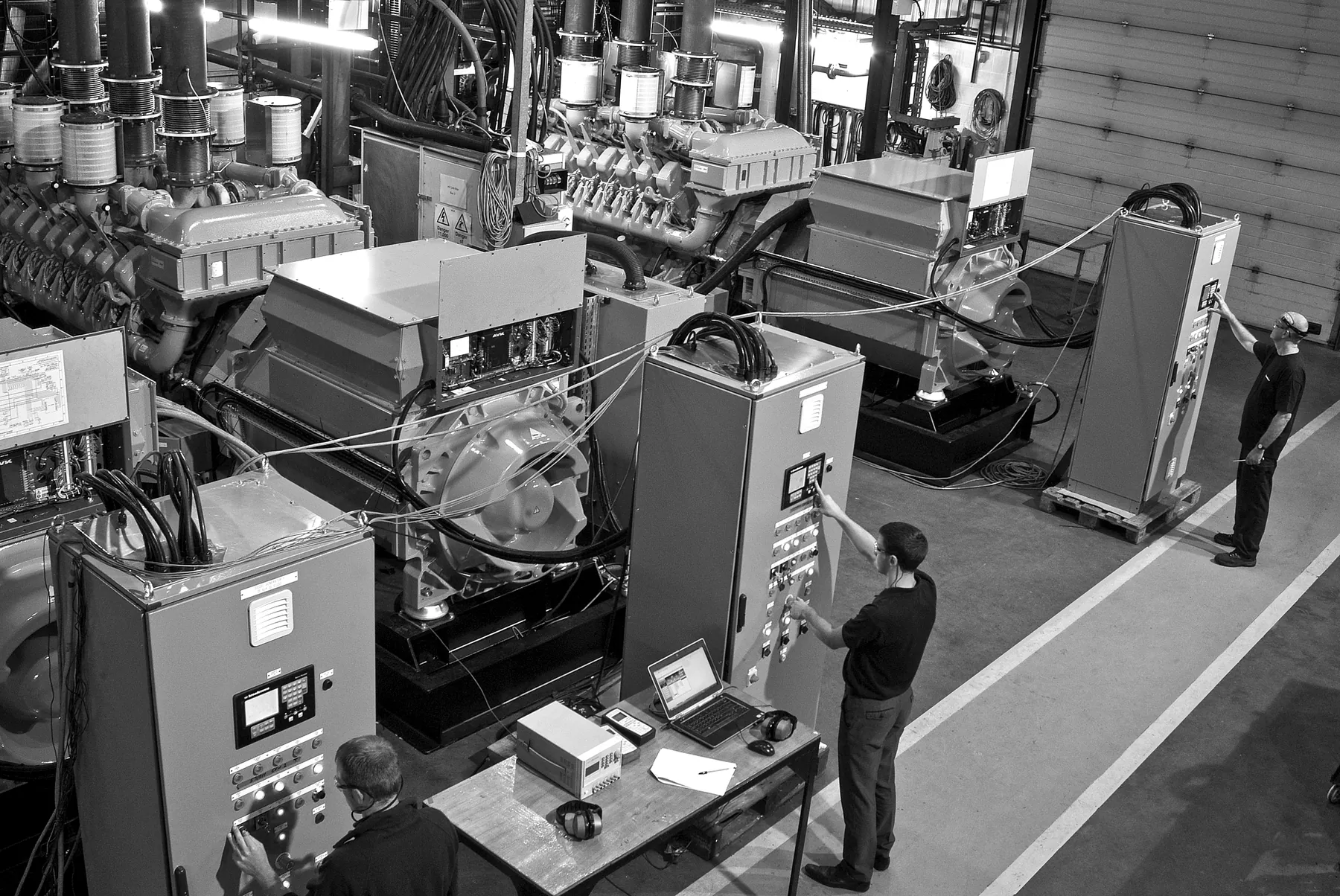
Applications


Products
PowerUP Energy Technologies develops and manufactures hydrogen fuel cell generators – from a portable 400 W unit to container solutions. Norwerk supplies the full range.
Standby power in a rack · PowerUP
UP3K fuel cells and batteries in a 19″ rack. The batteries take over in milliseconds, the fuel cell within seconds – fully automatic.
Portable generator
400 Wpower
Mobile backup, instruments, telecom masts and emergency response in the field.
Get a quote →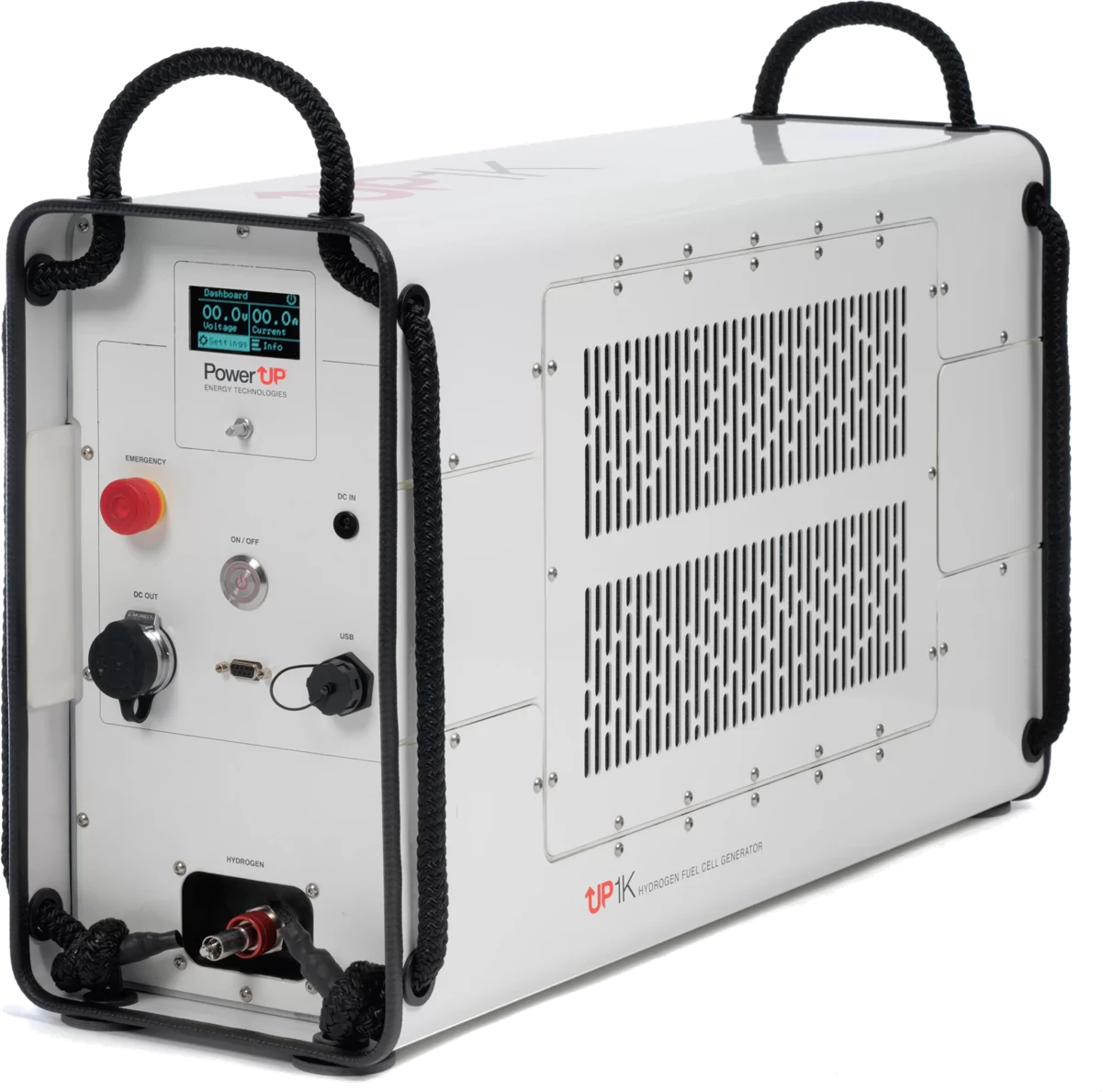
Portable generator
1,000 Wpower
Backup for 5G masts and emergency response where noise and exhaust are unacceptable.
Get a quote →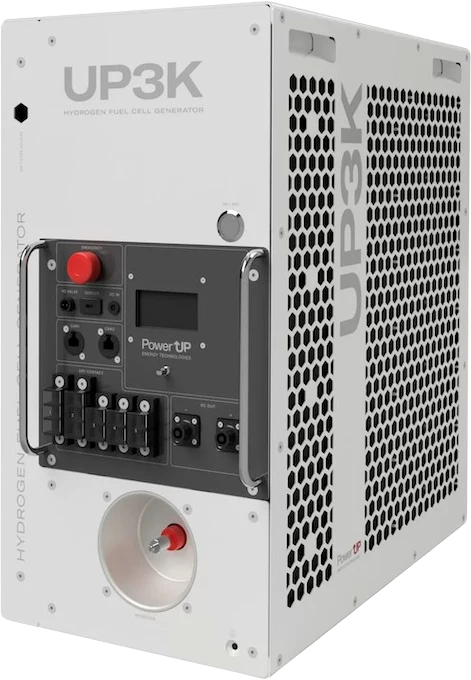
Compact generator
3,000 Wpower
The building block of UPSystem – also stand-alone or in parallel.
Get a quote →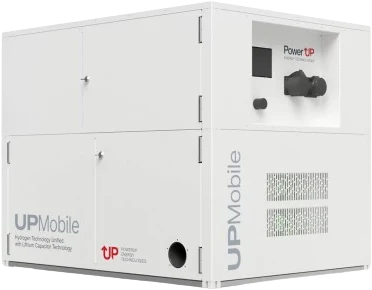
Mobile unit
10 kWpower
Temporary supply during service, on construction sites and at events – with battery for peak load.
Get a quote →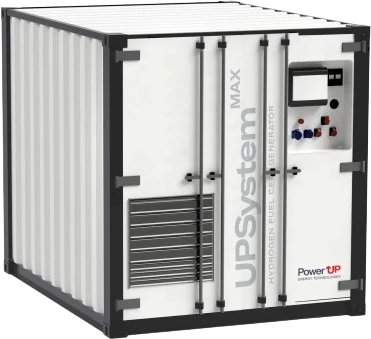
Container solution
Up to MW classpower
All-in-one container for larger critical plants.
Get a quote →| UP400 | UP1K | UP3K | UPMobile | |
|---|---|---|---|---|
| Power | 400 W | 1,000 W | 3,000 W | 10 kW (16.4 kW peak) |
| Output | 12/24 V DC | 12/24 V DC | 48 V DC | 42–75 V DC, 230/400 V AC |
| Hydrogen use | 66 g/kWh | 65 g/kWh | 65 g/kWh | 60–73 g/kWh |
| Hydrogen purity | > 99.95% | > 99.95% | > 99.95% | > 99.97% |
| Size (L × W × H) | 700 × 222 × 312 mm | 700 × 222 × 410 mm | 589 × 304 × 578 mm | 1900 × 1500 × 1500 mm |
| Weight | 21 kg | 27 kg | 42 kg | 220 kg |
| Operating temperature | −5 to 40 °C | −5 to 40 °C | −5 to 40 °C (−30 °C with accessories) | 5 to 60 °C |
| Operating life | – | – | 10,000 hours | 20,000 hours |
Data: PowerUP Energy Technologies. UP400 Industrial is a 400 W version for fixed industrial installations. UPSystem MAX data are project specific.
Higher power
For larger plants there are fuel cell modules such as HyPM™ and complete hydrogen generators such as HyFlex from Hitachi Energy, which replace the diesel generator on construction sites, at events and for critical supply. Our partner Bluecircle supplies HyFlex.
HyFlex at Bluecircle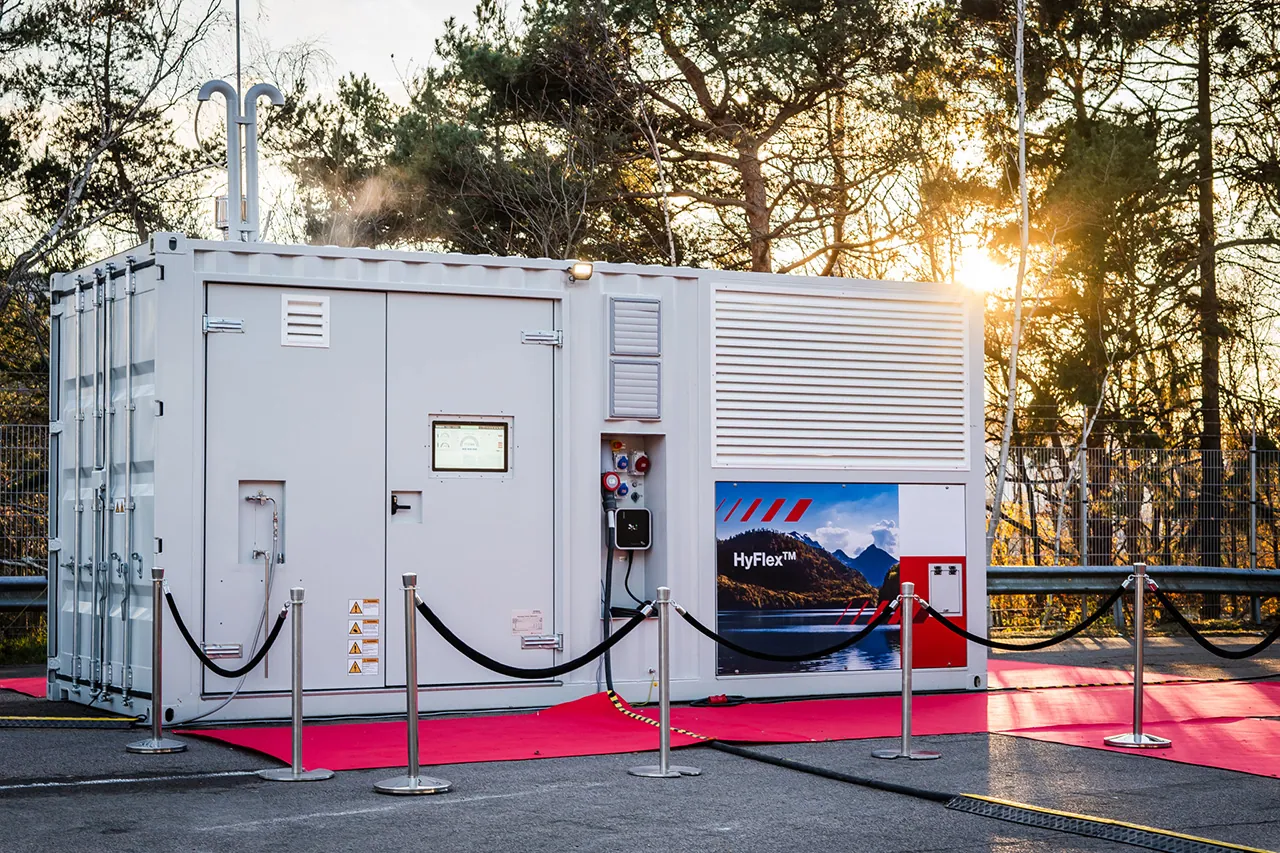
A fuel cell converts hydrogen and oxygen from the air into DC power, water and heat. As standby power it replaces the diesel generator: on a power failure a small battery buffer carries the load immediately, and the fuel cell starts and takes over within seconds.
As long as there is hydrogen. Run time depends on the load and the hydrogen store. PowerUP’s UP3K uses approx. 65 g of hydrogen per kWh, so 3 kW for 24 hours needs approx. 4.7 kg of hydrogen.
No. The fuel cell alone does not supply uninterrupted power, because it has to start. In a system such as PowerUP UPSystem the battery buffer provides the uninterrupted transfer and the fuel cell provides the long autonomy.
Not on site. The exhaust is water and heat. The overall climate impact depends on how the hydrogen is produced.
Storage of hydrogen cylinders follows the Danish Emergency Management Agency’s technical regulations for gases. Installation of stationary fuel cell power systems is covered by IEC 62282-3-300 and the safety of the system itself by IEC 62282-3-100. The municipal fire service is the authority for storage.
Typically at low to medium power, where noise, exhaust, indoor placement or environmental requirements rule out diesel – e.g. telecom, urban plant rooms, hospitals and temporary installations. At large ratings, diesel, HVO and DRUPS remain the most common.
Norwerk supplies PowerUP’s full range: UP400, UP1K, UP3K, UPSystem 3K and 6K, UPMobile and UPSystem MAX.
Send us the load, required autonomy and voltage level – or describe the task. We will come back with a solution sized for your operation.