Borri · Static transfer switch
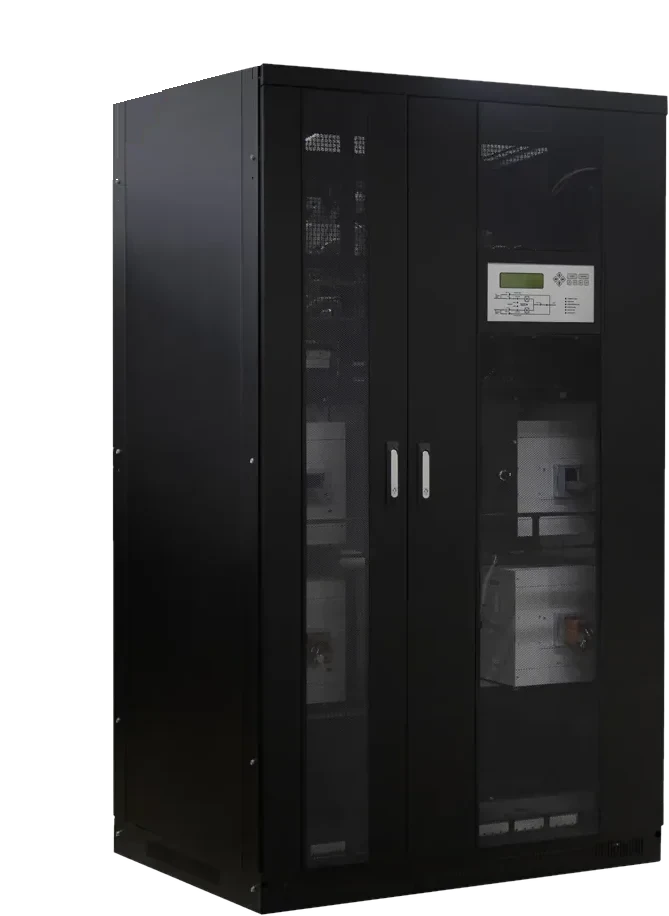
Borri STS 300: 3-phase static transfer switch, 100–2000 A
Centralised static transfer switch for dual-path supplies. STS 300 moves the load between two independent sources in at most 4 ms – without connecting the sources and without spreading a fault from one to the other.
Function
Why an STS is used, what happens on an outage, and why 4 ms is fast enough.
In short
What is a static transfer switch?
A static transfer switch connects one load to two independent supplies and switches between them with thyristors (SCR). With no mechanical parts, the transfer takes milliseconds.
In dual-path systems, equipment with two power supplies already has two sources. Equipment with only one power supply – or a whole distribution board – gets the two sources through the STS.
How it works
Three situations – three different responses
Choose a situation and see what the STS does. What matters is not only that it transfers fast – but that it knows when it must not transfer.
The load is supplied from the preferred source. The STS monitors voltage and frequency on both sources at all times.
Source 1 moves outside tolerance. The thyristors on source 1 turn off before source 2 turns on (break-before-make), so the sources are never connected. The transfer takes at most 4 ms.
The fault is downstream of the STS. A transfer would only move the short circuit onto source 2. The STS therefore inhibits the transfer, and the fault is cleared by the protection – source 2 stays healthy.
ITIC (CBEMA)
Why 4 ms is fast enough
The ITIC curve describes which voltage dips IT equipment typically rides through without stopping. A complete dropout may last up to 20 ms. STS 300 transfers in at most 4 ms – so the load does not notice the transfer.
STS 300 also transfers between sources that are not synchronised. The phase difference allowed for a transfer can be set from 5° to 30°.
Design
The functions that protect the sources and the load – and where the STS is placed.
Safety and redundancy
Built not to become the weak link
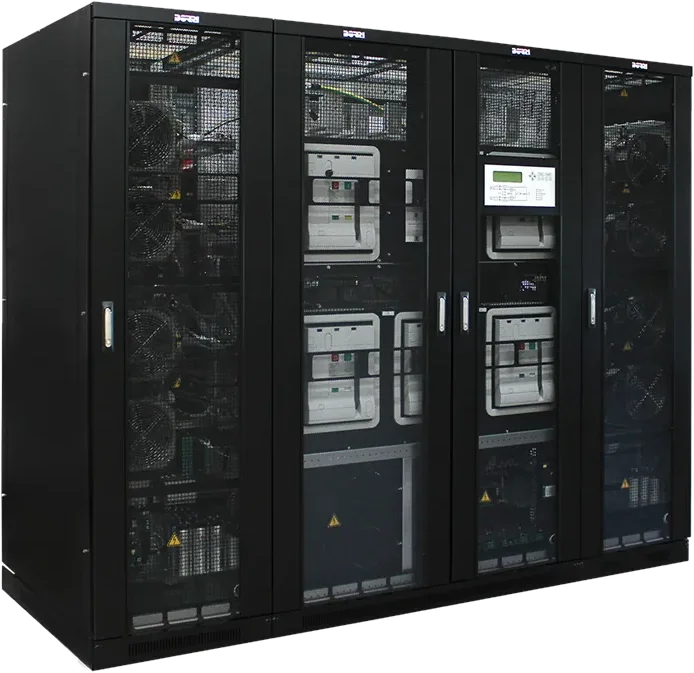
An STS sits right before the load. If it fails, the load is hit directly – no matter how many UPS systems stand in front of it. That is why the controls, supply and cooling in STS 300 are themselves redundant.
- 01Fuseless3- or 4-pole version without fuses in the main path. Thyristor fuses are available as an option.
- 02No cross-connectionBreak-before-make: source 1 is disconnected before source 2 is connected.
- 03Overlapping neutralIn 4-pole systems the neutral is switched with overlap, so the load is never without a neutral.
- 04Short circuit and inrushTransfer is inhibited on a short circuit in the load, and inrush currents are managed.
- 05Backfeed protectionDetection of open and shorted thyristors and input moulded case switches with backfeed protection.
- 06RedundancyDual power supply, dual control board and monitored fans. Triple power supply as an option.
- 07Dual manual bypassThe load can be placed directly on source 1 or source 2 during service.
- 08Overload125% for 10 min, 150% for 1 min, 1000% for 10 cycles and 2000% for 1 cycle.
Placement
Central STS or rack STS?
A central STS transfers a whole distribution board and all equipment behind it. A rack STS transfers only the equipment in the same rack. The choice depends on how many single-corded loads there are and where they are.
| Borri STS 300 | Borri STS 16-32 | |
|---|---|---|
| Placement | Central, before the distribution | In the rack, at the equipment |
| Phases | 3-phase | 1-phase |
| Rating | 100–2000 A | 16 / 32 A |
| Transfer time | ≤ 4 ms | 2–6 ms |
| Overload | 125% for 10 min | 125% for 1 min |
| Bypass | Dual manual bypass | Maintenance switch (option) |
| Size | From 820 × 835 × 1475 mm | 19″, 440 × 275 × 88 mm |
Source: Borri STS brochure, rev. D 01-25.
Models and data
Ten sizes from 100 to 2000 A and the technical data from Borri’s data sheet.
Models
Ten sizes from 100 to 2000 A
The size is chosen from the load current and the overload that may occur when transformers and distribution boards are energised. 1000 A is also available with top or bottom cable entry in a 1211 mm wide cabinet.
| Rating | W × D × H (mm) | Weight | Connection |
|---|---|---|---|
| 100 A | 820 × 835 × 1475 | 265 kg | Cable top or bottom |
| 250 A | 820 × 835 × 1475 | 290 kg | Cable top or bottom |
| 400 A | 811 × 980 × 2100 | 305 kg | Cable top or bottom |
| 630 A | 1211 × 980 × 2100 | 615 kg | Cable top or bottom |
| 800 A | 1211 × 980 × 2100 | 660 kg | Cable top or bottom |
| 1000 A | 2011 × 980 × 2100 | 700 kg | Cable or busbar top |
| 1250 A | 2011 × 980 × 2100 | 820 kg | Cable or busbar top |
| 1600 A | 2311 × 980 × 2100 | 1,150 kg | Busbar top |
| 1800 A | 2511 × 980 × 2100 | 1,280 kg | Busbar top |
| 2000 A | 2511 × 980 × 2100 | 1,400 kg | Busbar top |
At 100 and 250 A some features may not be available. Up to 3000 A on request.
Technical data
Common to all sizes
Input
| Connection | Hardwired, 3 or 4 wires |
|---|---|
| Nominal voltage | 380/400/415 V AC, 3-phase |
| Voltage tolerance | ±1% to ±20%, adjustable (default ±10%) |
| Frequency | 50/60 Hz, ±1% to ±10% (default ±5%) |
| Transfer phase angle | 5° – 30° |
Output
| Transfer time | ≤ 4 ms |
|---|---|
| Transfer mode | Break-before-make |
| Load power factor | 1 to 0.3 |
| Crest factor | 3:1 |
| Efficiency AC/AC | > 99 % |
System
| Front panel | Graphical LCD, mimic panel and keyboard |
|---|---|
| Communication | Relay card, RS232, RS485 and Modbus RTU. Option: SNMP, Modbus TCP/IP |
| Enclosure | IP20, RAL 9005 |
| Operating temperature | 0 – 40 °C |
| Noise | < 65 dBA / 1 m |
| Standards | IEC/EN 62310-1/-2/-3, IEC/EN 60947-3, IEEE 446 |
Source: Borri STS brochure (PDF) · borri.it
What is a static transfer switch (STS)?
A static transfer switch transfers a load between two independent supplies using thyristors instead of mechanical contacts. The transfer takes a few milliseconds, giving equipment with a single power supply access to two sources.
How fast does Borri STS 300 transfer?
Borri STS 300 transfers the load in at most 4 ms and switches break-before-make, so the two sources are never connected. That is within the ITIC curve’s 20 ms limit, which IT equipment typically rides through without stopping.
Why does the STS not transfer on a short circuit in the load?
If the short circuit is downstream of the STS, a transfer would only move the fault onto the other source. STS 300 therefore inhibits the transfer on a short circuit, so the other source stays healthy.
What is the difference between an STS and an automatic transfer switch (ATS)?
An ATS switches with mechanical breakers or contactors and is typically used between mains and generator, where the load is protected by a UPS. An STS switches electronically with thyristors and is used where the load must move between two UPS supplies without noticing.
Which sizes is Borri STS 300 available in?
Borri STS 300 is available from 100 to 2000 A in ten sizes and up to 3000 A on request. It comes in 3- or 4-pole versions for 380/400/415 V.
Can the STS be serviced without interrupting the load?
Yes. STS 300 has dual manual bypass, so the load can be placed directly on source 1 or source 2 while the STS is serviced. All components are accessible from the front.
What does overlapping neutral mean?
In 4-pole systems, STS 300 switches the neutral with overlap, so the load is never without a neutral during the transfer.
Do you have a project or a system that needs service?
Send us the load, required autonomy and voltage level – or describe the task. We will come back with a solution sized for your operation.