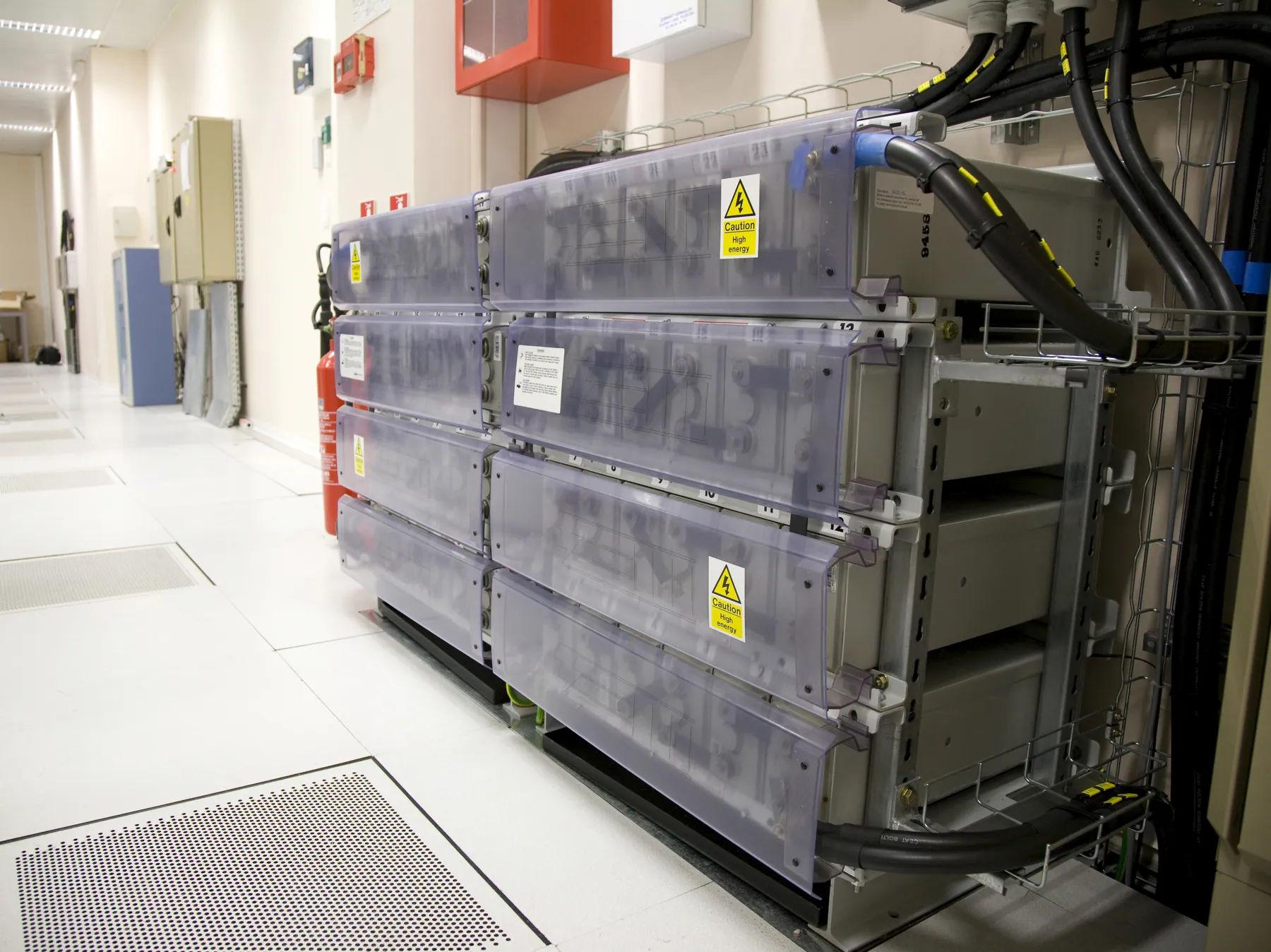
Knowledge page · UPS batteries
UPS batteries: life, sizing and testing
The battery is the part of a UPS that ages fastest and fails most often. Here is what determines its life, how it is sized, and how it is tested, housed and replaced.
The battery
The battery’s job in the UPS, and why one weak link can stop the whole supply.
In short
What does the battery do in a UPS?
In an online UPS the battery sits on the DC side between rectifier and inverter. In normal operation the rectifier keeps it fully charged. If the mains fails, the battery supplies the energy to the inverter – with no interruption for the load.
The battery rarely has to last long: typically minutes, until the generator has taken over. But it stands ready every day for many years and has to work the one time it matters.
Without batteries: Rotary UPS with flywheel
The weakest link
One weak block can stop the whole string
The blocks in a battery string are connected in series. The current has to pass through all of them, so the string is never stronger than its weakest block. That is why larger systems are built with parallel strings – and why every block is measured individually.
Source: Ponemon Institute, National Survey on Data Center Outages (2010), US respondents.
Both strings share the load. All blocks are healthy.
With only one string, one weak block breaks the whole circuit. The UPS has no battery when the mains fails.
String B carries the load alone. The supply holds – but autonomy is shorter until the block is replaced.
Life
Which battery types are used, and what decides how long they last.
Technologies
Lead or lithium – and which class?
Most UPS systems use valve-regulated lead-acid batteries (VRLA). Eurobat, the association of European battery manufacturers, divides them into four classes by design life at 20 °C. The class is stated in the manufacturer’s data sheet.
Norwerk mainly uses CSB batteries in our UPS solutions and services all major battery brands.
| Type | Life | Maintenance | Note |
|---|---|---|---|
| VRLA (AGM) | 3–5 to 10/12 years design life by Eurobat class | No topping up – but must be measured and tested | The most common in UPS. Sensitive to heat. |
| VRLA (gel) | More than 12 years for the longest-lived ranges | As AGM | E.g. Sonnenschein A400 and A600 in Eurobat’s highest class. |
| Vented lead-acid | E.g. 16–18 years on standby at 20–25 °C (BAE OGi) | Topping up and measurements to IEEE 450 | Release far more hydrogen than VRLA. Need a battery room. |
| Lithium-ion (LFP, NMC) | Often stated 15–20 years design life; field data is still limited | Battery management system (BMS) monitors every cell | 50–70 % lighter and smaller than lead-acid. Fire risk from thermal runaway. |
Sources: Eurobat (2022), GNB/Exide Eurobat overview (2023), BAE OGi data sheet, EnerSys and Schneider Electric White Paper 229 on lithium-ion.
Temperature
Every 10 °C above 20 °C halves the life
Heat accelerates corrosion in the lead-acid battery’s plates. Eurobat states 50 % shorter life per 10 °C constant temperature rise above 20 °C – and above 40 °C the float current can run away. Choose design life and temperature and see the expected life.
Design life at 20 °C
Battery room temperature
≈ 5.0 yearsexpected life
Design life and reality
The battery holds – until suddenly it does not
Design life is measured in the laboratory at 20 °C with ideal charging. In service it is shorter: Riello UPS expects a battery with a 9–10-year design life to typically need replacement after 6–8 years.
Capacity is stable for many years and then falls quickly. IEEE 1188 and IEEE 450 consider the battery at end of life at 80 % of rated capacity. That is why sizing multiplies by 1.25.
Sizing
How load and autonomy become an actual battery.
Sizing
From kW and minutes to watts per cell
A UPS draws constant power from the battery. Sizing is therefore done in watts per cell at the required autonomy – not in ampere-hours. Rated capacity in Ah applies to a 10-hour discharge to 1.80 V per cell; a UPS discharges in minutes.
Choose load and autonomy. The example assumes 40 blocks of 12 V in one string – the actual UPS may have a different number.
Load
Autonomy
Find a block that delivers at least 3,618 W for 10 min to 1.67 V per cell – in the manufacturer’s constant power table.
The autonomy does not change the power. It decides which column of the table the block must meet.
- 1Load on the UPS100 kW
- 2÷ inverter efficiency 0.95105 kW
- 3× ageing factor 1.25132 kW
- 4× design margin 1.10145 kW
- 5÷ 240 cells (40 blocks of 12 V)603 W
Ageing factor 1.25 and design margin 10–15 % per IEEE 485 practice; Eurobat also recommends 125 % for age. Efficiency and number of cells are assumptions in the example. Always check against the UPS and battery manufacturer’s data.
Operation
How the battery is kept ready, where it stands, and how it is replaced.
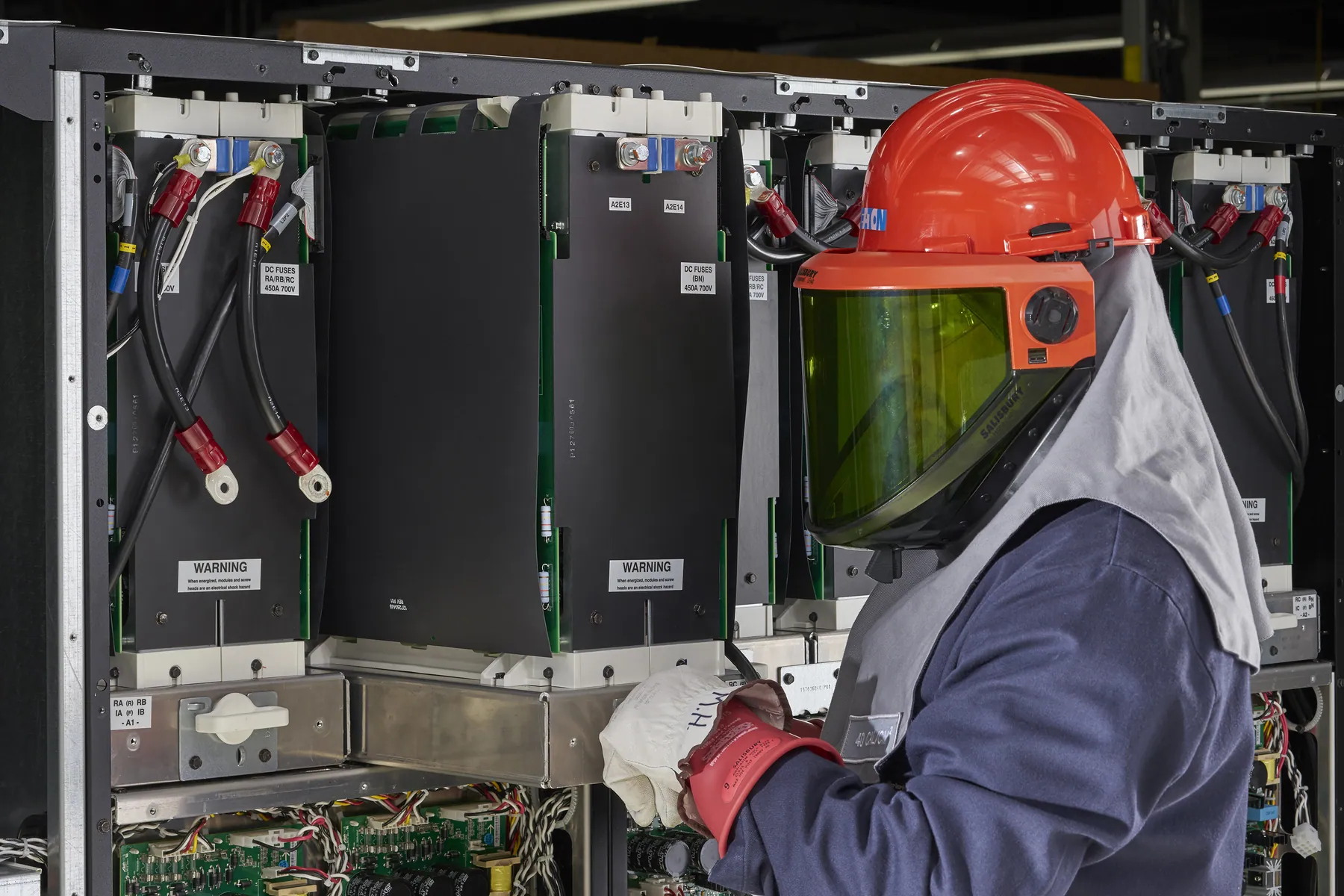
Testing and maintenance
“Maintenance-free” does not mean unchecked
VRLA batteries need no water, but they do need measuring. Internal resistance readings find weak blocks early – but only a capacity test proves that the battery can deliver the autonomy.
| Interval | What |
|---|---|
| Every quarter | Visual check, cleanliness and terminals · room and cabinet temperature · voltage per block and in total |
| Every six months | As quarterly + internal resistance or conductance per block – compared with previous readings |
| Every year | As six-monthly + check of connections: re-torque if connection resistance has risen more than 20 % |
| Capacity test | At commissioning, then at least every 2 years and yearly as capacity falls. Below 80 % the battery is replaced |
Sources: CSB installation and operating instructions for VRLA (quarterly, six-monthly, yearly) and IEEE 1188 (capacity test, 80 %). Norwerk’s technicians work to IEEE 1188 and IEEE 450.
Battery room
Ventilation, hydrogen and fire
Lead-acid batteries release hydrogen during charging – VRLA far less than vented batteries, but never zero. EN IEC 62485-2 calculates the required air flow:
Q = 0.05 · n · Igas · Crt · 10−3 m³/h
n is the number of cells, Crt the capacity in Ah, and Igas for VRLA is 1 mA/Ah on float and 8 mA/Ah on boost charge. Example: 240 cells of 100 Ah give 1.2 m³/h on float and 9.6 m³/h on boost. With natural ventilation, inlet and outlet must each be at least 28 · Q cm².
Lithium-ion releases no hydrogen in normal operation but can go into thermal runaway. IEC 62485-5 applies, and the Danish Emergency Management Agency has guidance on fire protection of larger lithium-ion installations (2023). A draft notification requirement for lithium-ion installations over 100 kWh in buildings was under consultation in November 2025 – check the status with the local fire service.
Replacement
Replace in time – and replace it all
Norwerk delivers UPS battery replacement as one job: choice of battery, removal and disposal of the old ones, installation and testing of the new – and a check that the battery works correctly with the UPS.
New batteries self-discharge in storage. CSB recommends recharging every 6 months below 25 °C and every 3 months at 25–30 °C. Producers of industrial batteries must take back waste batteries free of charge under Regulation (EU) 2023/1542, and from 18 February 2027 industrial batteries over 2 kWh must carry a digital battery passport.
- 1ConditionReadings and capacity test
- 2New batteryFresh: stored max. 6 months uncharged
- 3The whole stringNew and old blocks are not mixed
- 4Acceptance testCapacity and interaction with the UPS
- 5DisposalUnder the EU Batteries Regulation
How long does a UPS battery last?
It depends on the battery’s design life and above all on the temperature. Eurobat divides VRLA batteries into classes from 3–5 years to more than 12 years at 20 °C. In practice batteries are replaced before their design life because capacity drops below 80 %. In constant operation above 20 °C, life halves for every 10 °C.
What is the difference between design life and service life?
Design life is determined in the laboratory at 20 °C with ideal charging. Service life depends on temperature, charging, discharges and maintenance, and is normally shorter. Riello UPS, for example, expects a battery with a 9–10-year design life to need replacement after approx. 6–8 years.
When should UPS batteries be replaced?
IEEE 1188 and IEEE 450 consider a battery at end of life when capacity is below 80 % of rated. After that, capacity drops quickly. The whole string should be replaced at once so new and old blocks are not mixed.
How are UPS batteries tested?
With regular measurements of voltage, temperature and internal resistance or conductance, which reveal weak blocks, and with a capacity test in which the battery is discharged under control. Only the capacity test proves that the battery can deliver the autonomy it was sized for.
How is a UPS battery sized?
The load is divided by the inverter efficiency and multiplied by an ageing factor of 1.25, so the battery can still do the job at 80 % capacity, and often by a design margin. The result is divided by the number of cells and compared with the manufacturer’s constant power table at the required autonomy.
Is lithium-ion better than lead-acid in a UPS?
Lithium-ion is 50–70 % lighter and smaller and often has a stated design life of 15–20 years, but field data on long life is still limited and the price is higher. The fire risk from thermal runaway calls for a battery management system and an assessment of the room. The choice depends on space, weight, temperature and life-cycle cost.
Does a battery room need ventilation?
Yes. Lead-acid batteries release hydrogen during charging, VRLA batteries too, though far less than vented batteries. EN IEC 62485-2 sets out how to calculate the required air flow and the size of the inlet and outlet openings.
What happens to the old batteries?
Under the EU Batteries Regulation (EU) 2023/1542, producers of industrial batteries must take back waste batteries free of charge. When Norwerk replaces batteries, we take the old ones with us and see to correct disposal.
Do you have a project or a system that needs service?
Send us the load, required autonomy and voltage level – or describe the task. We will come back with a solution sized for your operation.