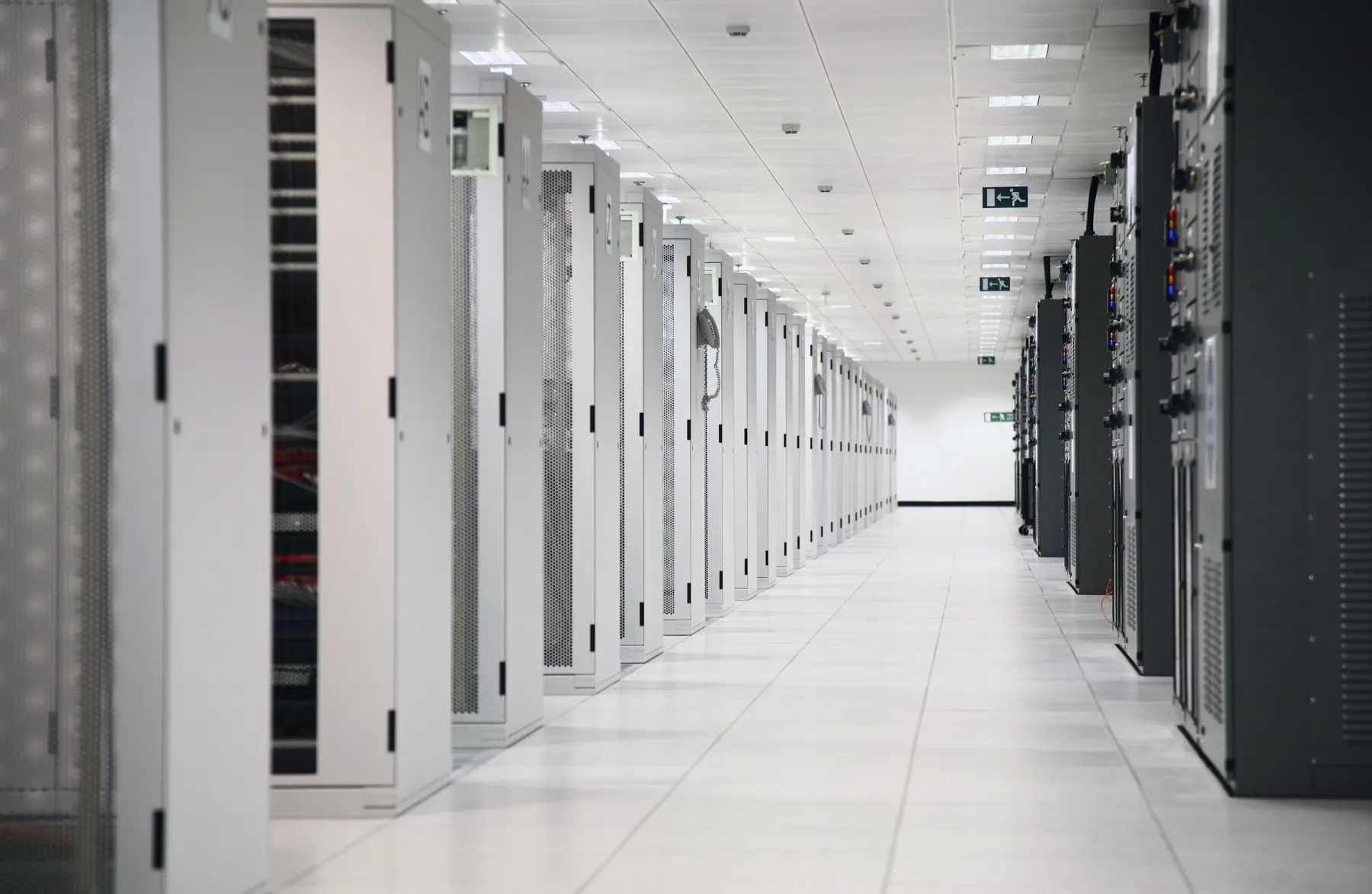
Knowledge page · Data centre
Data centres: power, cooling and efficiency
A data centre is a building that must deliver power and cooling to the IT equipment without pause. Here is the power path all the way to the server, the requirements for availability and temperature – and the figures data centres over 500 kW must now report.
Power
How the power reaches the server, and how the path is made robust.
In short
The power path from grid to server
The power passes many links before it reaches the server: transformer, main switchboard, UPS, distribution board (PDU) and the outlets in the rack. The generator plant connects at the main switchboard, and the UPS with battery or flywheel bridges until it has taken over.
Every link can fail. That is why a data centre’s uptime depends as much on the distribution after the UPS as on the UPS itself.
A/B supply
Two paths all the way to the rack
In a redundant data centre every rack gets two supplies, A and B, from separate UPS systems and switchboards. Most servers have two power supplies and can use both paths. Choose a situation and see what happens.
The redundancy only holds if each path can carry the whole load alone. If A and B are each loaded above 50 %, the remaining path trips when the other drops out.
The server has two power supplies (PSUs), each connected to its own supply path. Each PSU can carry the whole server alone.
Supply A is gone. PSU 2 takes over without interruption, because B is an independent path – all the way back from UPS and switchboard.
Equipment with only one power supply gets access to both paths through a static transfer switch (STS), which transfers in a few milliseconds.
EN 50600
Four availability classes
The European data centre standard EN 50600 divides power supply and distribution into four classes. The class is chosen from what an outage costs – and the same class should apply to cooling and cabling.
| Class | Design | Means |
|---|---|---|
| Class 1 | One path, no redundancy | A fault or maintenance stops the supply |
| Class 2 | One path with redundant components | Tolerates a fault in e.g. one UPS module, not in the path |
| Class 3 | Multiple paths | One path can be maintained while the other carries the load |
| Class 4 | Multiple paths, fault tolerant | Tolerates a fault – except during maintenance |
Source: EN 50600-2-2 (power supply and distribution).
Cooling
How warm the air may be, how it is controlled, and how much heat a rack gives off.
Temperature and air
18–27 °C at the server front
ASHRAE recommends 18–27 °C in the air the IT equipment draws in. It is the temperature at the front of the server that counts – not the room average. Ordinary servers (class A1) tolerate 15–32 °C, but those are limits, not operating points.
Racks stand front to front in a cold aisle and back to back in a hot aisle. When the cold aisle is closed with roof and doors (containment), the air does not mix, and the cooling can run at a higher temperature with less energy.
Source: ASHRAE TC 9.9, Thermal Guidelines for Data Processing Environments, 5th edition (2021).
Density
Every kW in the rack is a kW of heat
Almost all the power a rack uses becomes heat that the cooling must remove. That is why UPS, distribution and cooling are sized from the same power per rack.
Uptime Institute’s 2025 survey shows an average of 7.6 kW per rack. More racks are now at 10–30 kW, while racks above 50 kW are still rare – but AI equipment is pushing up.
Efficiency
How much energy goes to things other than IT – and what must be reported.
PUE
What does the IT power cost in total?
PUE shows how much energy the data centre uses in total for every kWh that reaches the IT equipment. The rest goes to cooling, losses in UPS and distribution, lighting and other. Uptime Institute has measured a weighted average just above 1.5 – almost unchanged for six years. Choose the consumption and see the PUE.
Cooling relative to the IT load
Losses in UPS and distribution
PUE 1.48incl. 3 % for lighting and other
Reporting
Above 500 kW the figures must be disclosed
Data centres with an installed IT power demand of at least 500 kW must report energy data and KPIs for the previous year to the EU database on data centres by 15 May each year. The requirement comes from Article 12 of the Energy Efficiency Directive and Delegated Regulation (EU) 2024/1364.
In Denmark the requirement is implemented by Executive Order no. 926 of 9 July 2024, and the Danish Energy Agency supervises. It requires that energy to IT can be metered separately from the rest of the data centre.
- 1MeteringEnergy to IT and to the whole data centre
- 2KPIsE.g. PUE, water use (WUE) and energy reuse (ERF)
- 3ReportingTo the EU database by 15 May
- 4SupervisionThe Danish Energy Agency can issue orders
Norwerk
What we supply and service for data centres.
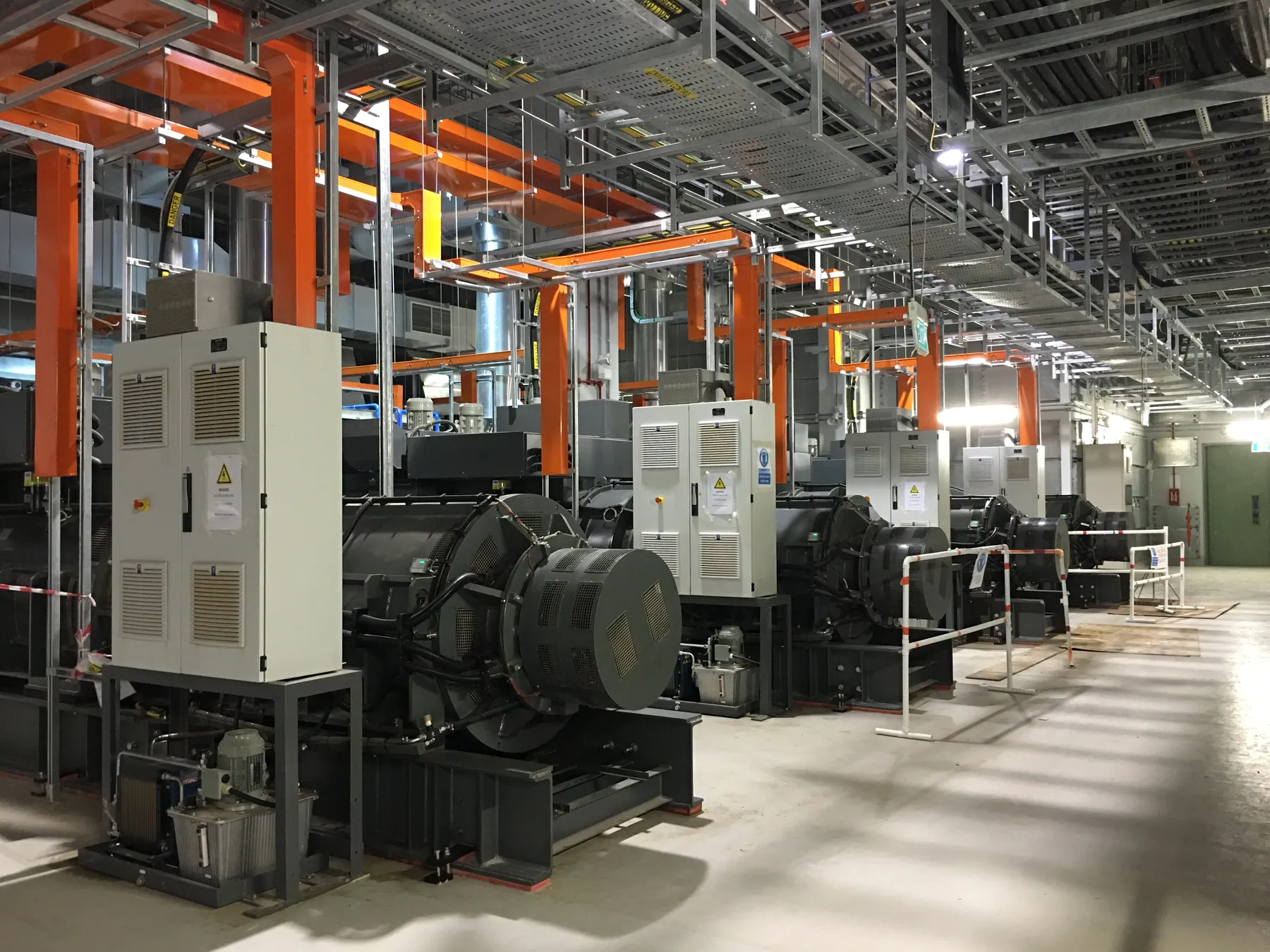
Norwerk
The power supply for your data centre
Norwerk designs, supplies and services standby power for data centres – from a single UPS to the whole chain with generator and STS. We load test the systems before they go into operation.
| Area | What |
|---|---|
| UPS systems | Borri single- and three-phase UPS, also modular |
| Rotary UPS | DRUPS and flywheels from Piller and HITEC |
| STS | Borri STS 300 for single-corded equipment |
| Generator plants | Diesel generators for long autonomy |
| UPS batteries | Supply, testing and replacement |
| Fuel cells | Hydrogen as standby power for smaller sites |
What are the availability classes in EN 50600?
EN 50600 divides the data centre’s power supply and distribution into classes 1 to 4. Class 1 is a single path without redundancy, class 2 a single path with redundant components, class 3 multiple paths so one can be maintained during operation, and class 4 multiple paths that tolerate a fault.
What is A/B supply?
Each rack is supplied from two independent paths, A and B, typically from separate UPS systems. Servers with two power supplies connect to both paths and keep running if one fails. Equipment with one power supply needs a static transfer switch.
How warm may a data centre be?
ASHRAE recommends 18–27 °C in the air drawn into the IT equipment. It is the inlet temperature at the front of the server that counts – not the room average.
What is PUE?
Power Usage Effectiveness is the data centre’s total energy consumption divided by the IT equipment’s energy consumption, defined in ISO/IEC 30134-2. A PUE of 1.5 means that for every kWh to IT, 0.5 kWh is used for cooling, losses and other.
Which data centres must report energy data?
Data centres with an installed IT power demand of at least 500 kW must report energy data and KPIs to the EU database by 15 May each year. In Denmark this follows from Executive Order no. 926 of 9 July 2024, supervised by the Danish Energy Agency.
How much power does a rack use?
Uptime Institute’s 2025 survey shows an average of 7.6 kW per rack. More racks are now at 10–30 kW, while racks above 50 kW are still rare.
What does Norwerk supply to data centres?
Norwerk designs, supplies and services the power supply: Borri UPS systems, rotary UPS, static transfer switches, generator plants, fuel cells and UPS batteries – plus load testing of the systems.
Do you have a project or a system that needs service?
Send us the load, required autonomy and voltage level – or describe the task. We will come back with a solution sized for your operation.