
Knowledge page · Service
Servicing emergency power systems
An emergency power system stands idle most of the time – and must work the first time it is called on. Here is what fails most often, the parts that wear, and what a service agreement must secure.
The faults
Where outages start, and why most can be prevented.
Causes
The power supply is the most common cause
In Uptime Institute’s 2025 analysis, 54 % of data centre respondents name the power supply as the cause of their most recent serious outage. Among power-related outages, the UPS, the transfer switch and the generator are the most frequent sources.
These are exactly the units that stand idle most of the time. A fault is therefore only discovered when they have to work – unless they are measured, tested and maintained to a plan.
Wear parts
The components that age, however well the system is looked after.
UPS
Fans, capacitors and batteries
A UPS has three groups of parts with limited life. The fans are mechanical and wear out. The capacitors age chemically and can eventually send the UPS to bypass – leaving the load unprotected. The batteries are replaced based on measurements and capacity tests.
Vertiv recommends replacing fans after 5 years and capacitors after 6 years on average. Eaton recommends replacing both at the same time, typically after around 7 years, so they do not fail one by one.
Generator plants
Five things that decide whether the generator starts
A generator that is only run weekly without load can look healthy and still fail during a real outage. Service checks the conditions that decide whether it starts and takes the load.
| Item | Why |
|---|---|
| Starting batteries | The generator only starts if they have enough voltage |
| Preheating | A cold engine starts slower and takes the load later |
| Fuel | Diesel ages in the tank and can cause filter problems |
| Coolant and oil | Level, condition and leaks are checked |
| Load | If the engine only runs without load, wet stacking occurs |
The agreement
What happens when something fails – and what must be ready.
Response time
From alarm to engineer on site
The most important part of a service agreement is how quickly an engineer is on site. Norwerk offers on-site response within 2, 4 or 8 hours around the clock, and an engineer calls back no later than 15 minutes after the call. Choose a response time and see the sequence.
In extreme weather all Norwerk engineers are on standby, and planned maintenance is postponed so emergency calls come first.
- 1Alarm or callAround the clock
- 2Engineer calls backWithin 15 min
- 3Engineer on siteWithin 4 hours
- 4The fault is fixedWith parts from stock
Spare parts
The part must be there before the fault
Lead times for some parts can be weeks or months. Meanwhile the system runs without redundancy. Norwerk divides spare parts into three categories and builds the package around the actual installation – always original parts per the system documentation.
| Category | Content |
|---|---|
| Operational | Consumables and wear parts for commissioning and the first years |
| Recommended | Parts covering the need through the system’s life, tailored to the installation |
| Critical | Large components with long lead time and major impact on downtime |
Services
All Norwerk services in one place.
Services
One service responsibility for the whole chain
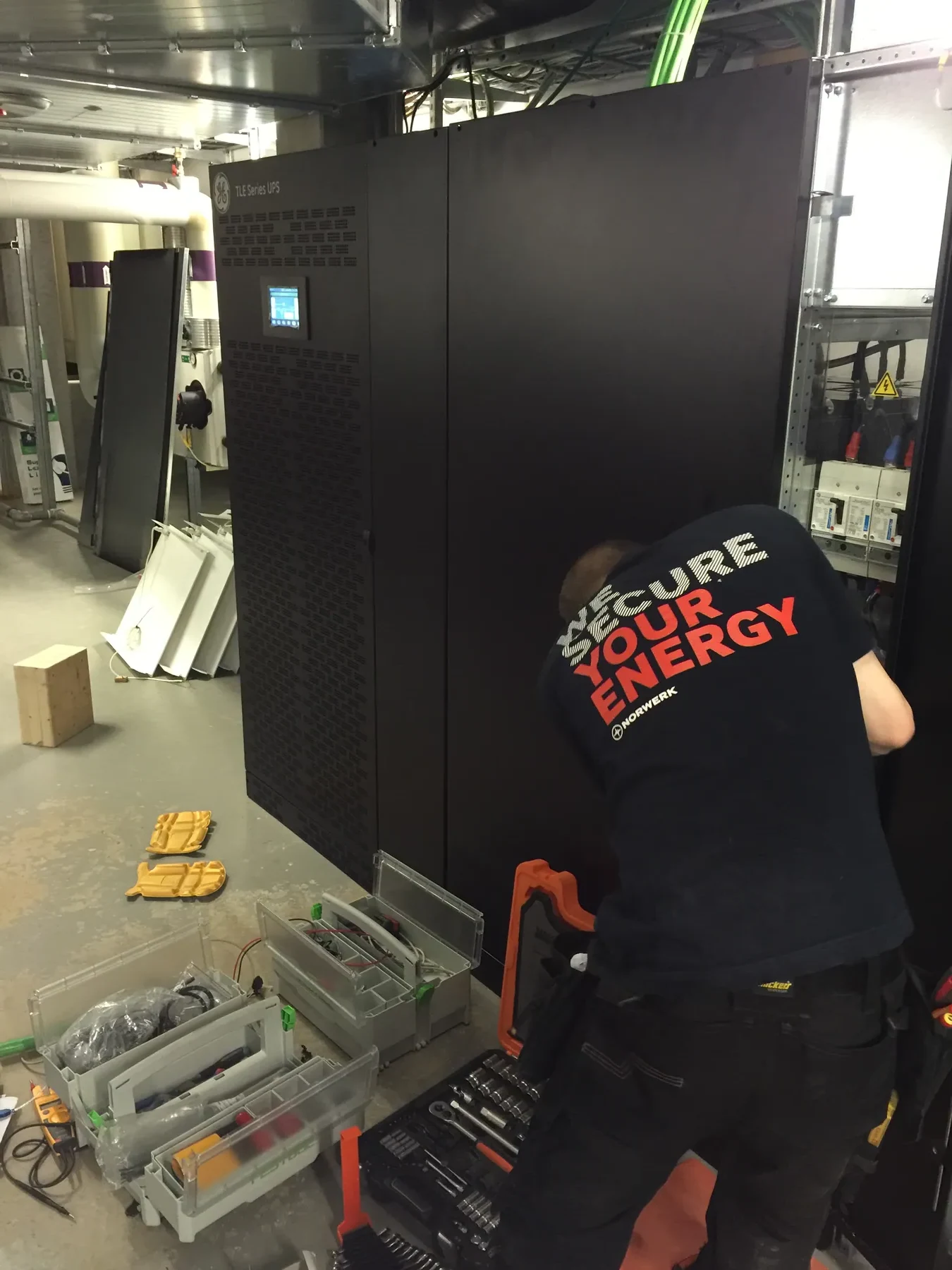
Norwerk services every link in the emergency power supply – UPS systems, batteries, generator plants, transfer switches and distribution – regardless of make. That gives one place to call when something fails.
| Service | What |
|---|---|
| Preventive maintenance | Planned service of the whole emergency power system |
| Emergency service | Round-the-clock service with agreed response time |
| Emergency call procedure | How a call-out works |
| UPS service | Static UPS systems regardless of make |
| UPS battery service | Measurement, testing and replacement |
| Diesel generator service | Maintenance of generator plants |
| Load bank testing | Testing at full load with a load bank |
| Spare parts service | Spare parts packages for the installation |
| Monitoring | Alarms and operating data from the system |
| Site check and UPS audit | Review of power quality and systems |
| Capacity report and health check | Overview of server room capacity |
Why must an emergency power system be serviced?
Because it stands idle most of the time and has to work the first time it is called on. Uptime Institute’s 2025 analysis shows that the power supply is the most common cause of serious data centre outages – most often the UPS, the transfer switch or the generator.
What is the difference between preventive and corrective maintenance?
Preventive maintenance is planned before anything fails: inspection, measurements, tests and replacement of wear parts. Corrective maintenance is repair after a fault has occurred. The better the preventive work, the less often corrective work is needed.
When should fans and capacitors in a UPS be replaced?
Vertiv recommends replacing fans after 5 years and AC and DC capacitors after 6 years on average. Eaton recommends replacing fans and capacitors at the same time, typically after around 7 years. The actual interval depends on model and operating conditions.
How quickly does Norwerk respond to a fault?
It depends on the service agreement. Norwerk offers on-site response within 2, 4 or 8 hours, and an engineer calls back within 15 minutes.
Why keep spare parts on site?
Lead times for some parts can be weeks or months. If the most important parts are ready, a fault can be fixed at once instead of the system running without redundancy while waiting.
Does Norwerk only service systems Norwerk has supplied?
No. Norwerk services UPS systems, batteries, generator plants, transfer switches and distribution regardless of make.
Do you have a project or a system that needs service?
Send us the load, required autonomy and voltage level – or describe the task. We will come back with a solution sized for your operation.